The bridge
Parent access
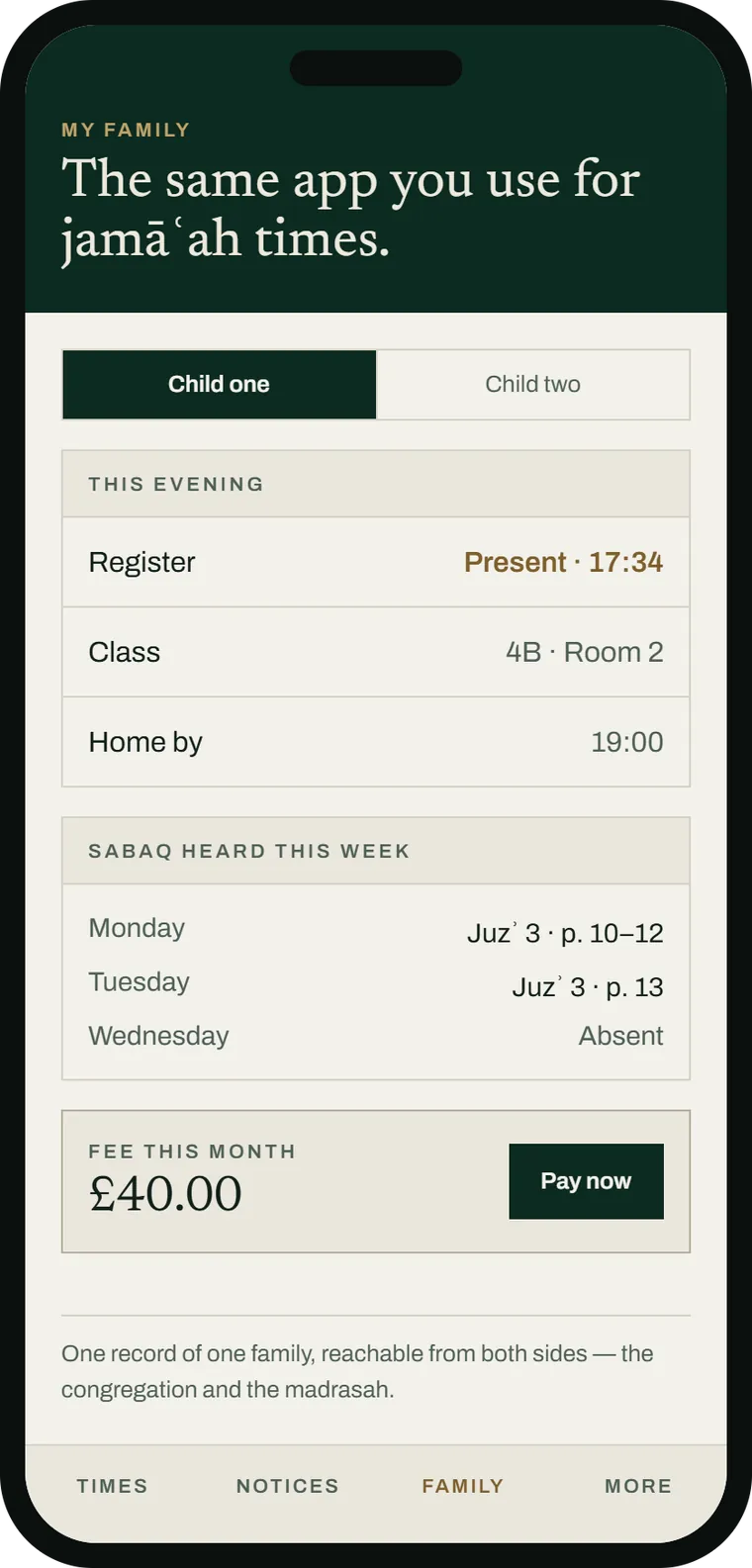
A parent opens the app they already have for jamāʿah times and finds their own child: the register marked this evening, the sabaq heard this week, the fee due this month. One record of one family, reachable from both sides.
Prayer times, the congregation app, your website, the hall screens and donations are live today. The madrasah — registers, fees, Hifz and parent access — is built on the same record of the same family, and already holds a Bolton masjid’s full roll.
Interface previews · example data, no masjid named
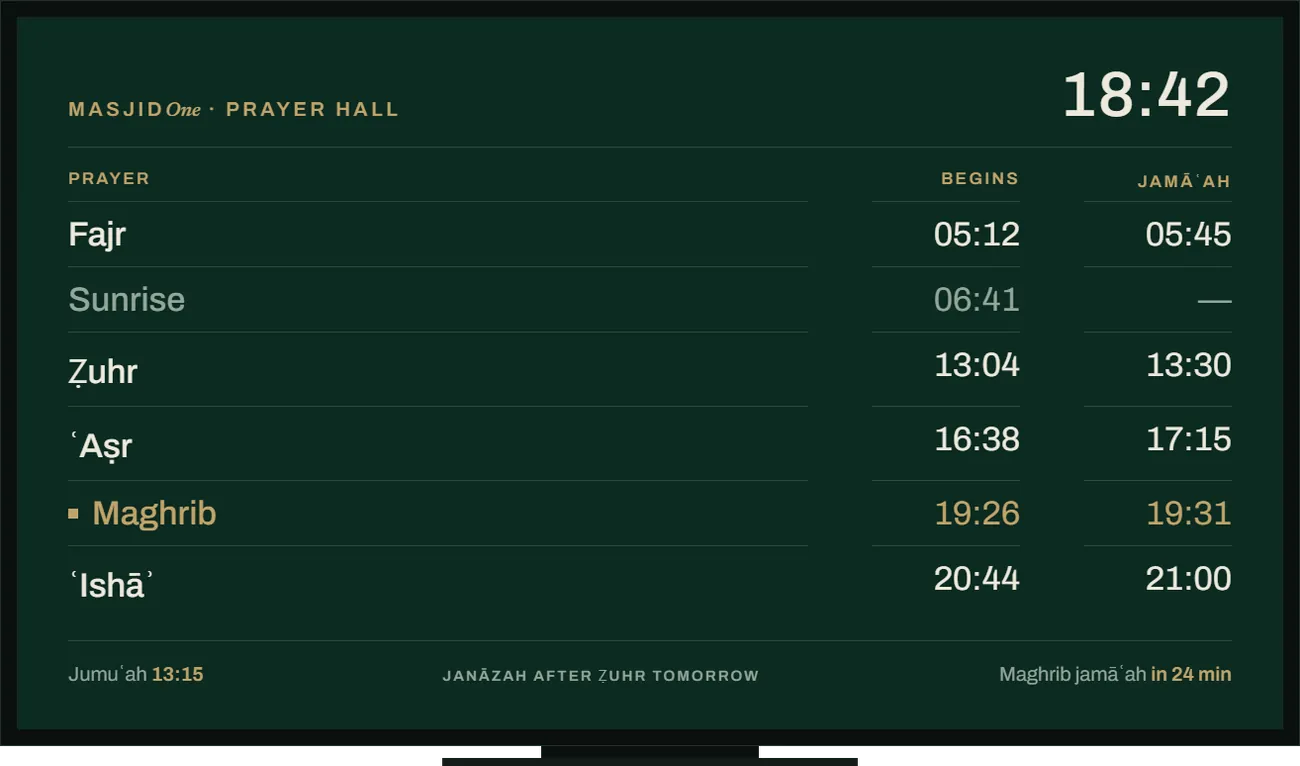
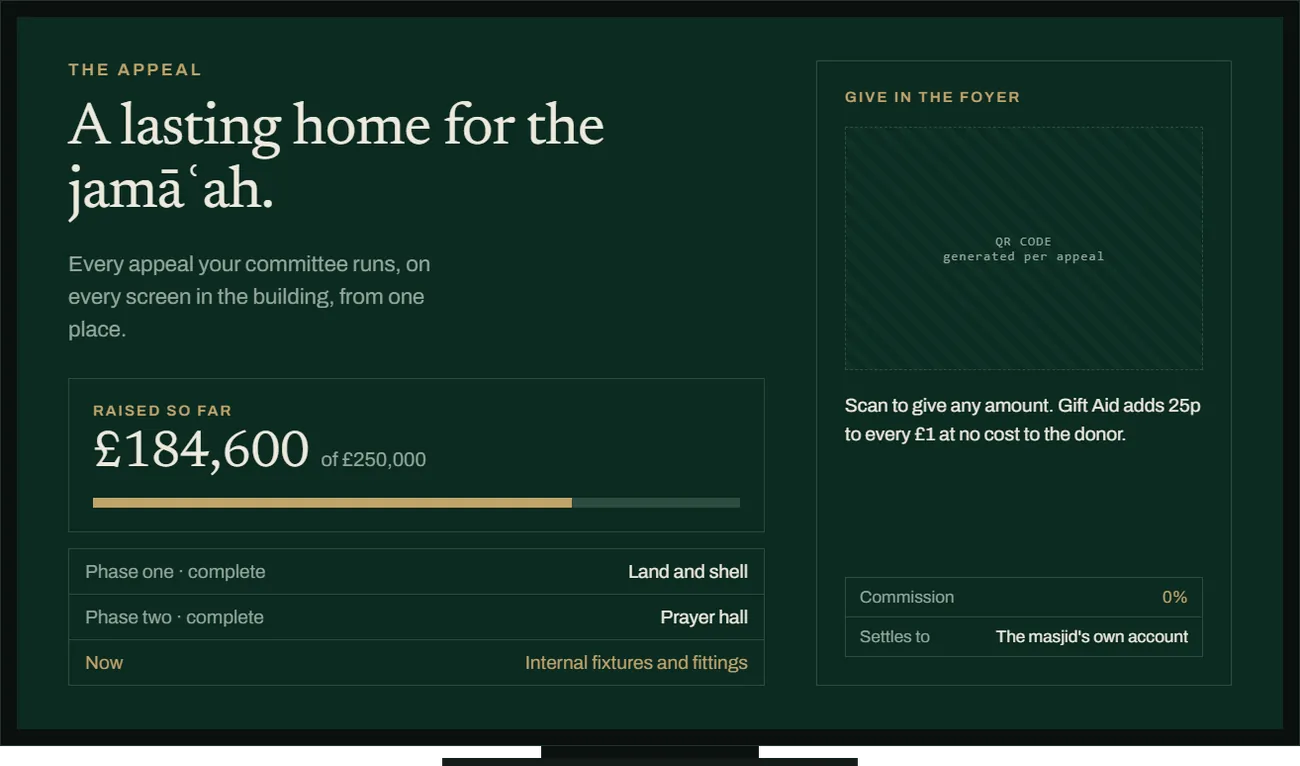
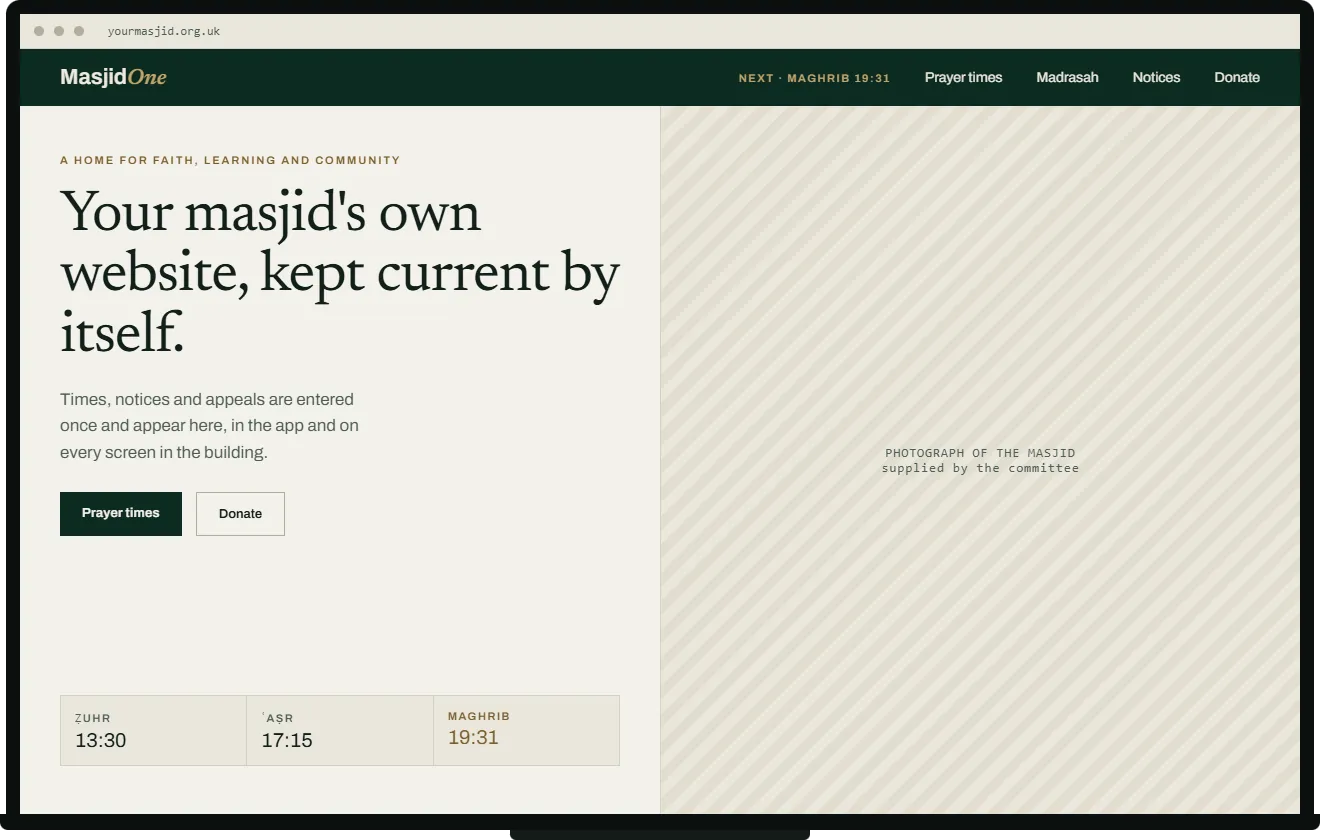
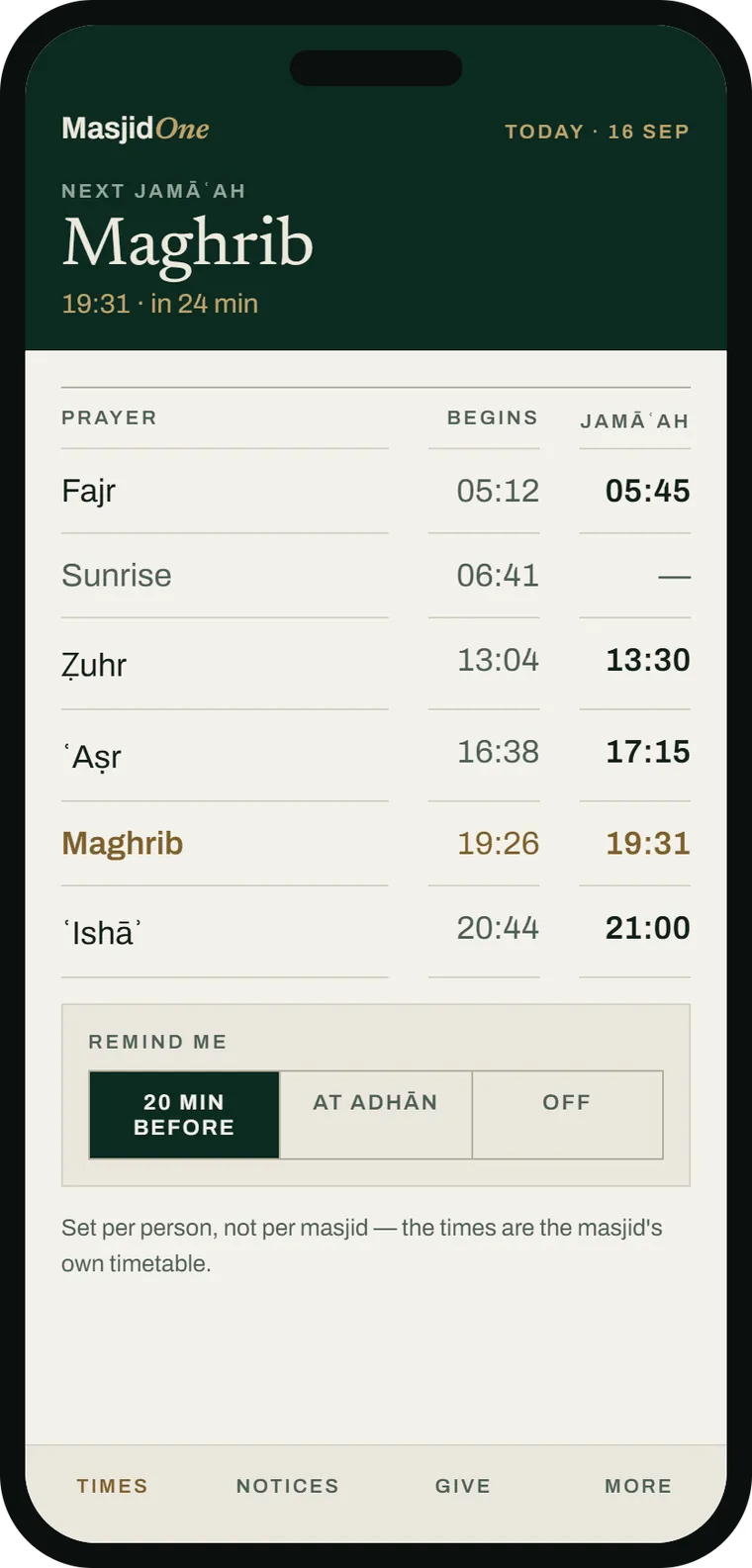
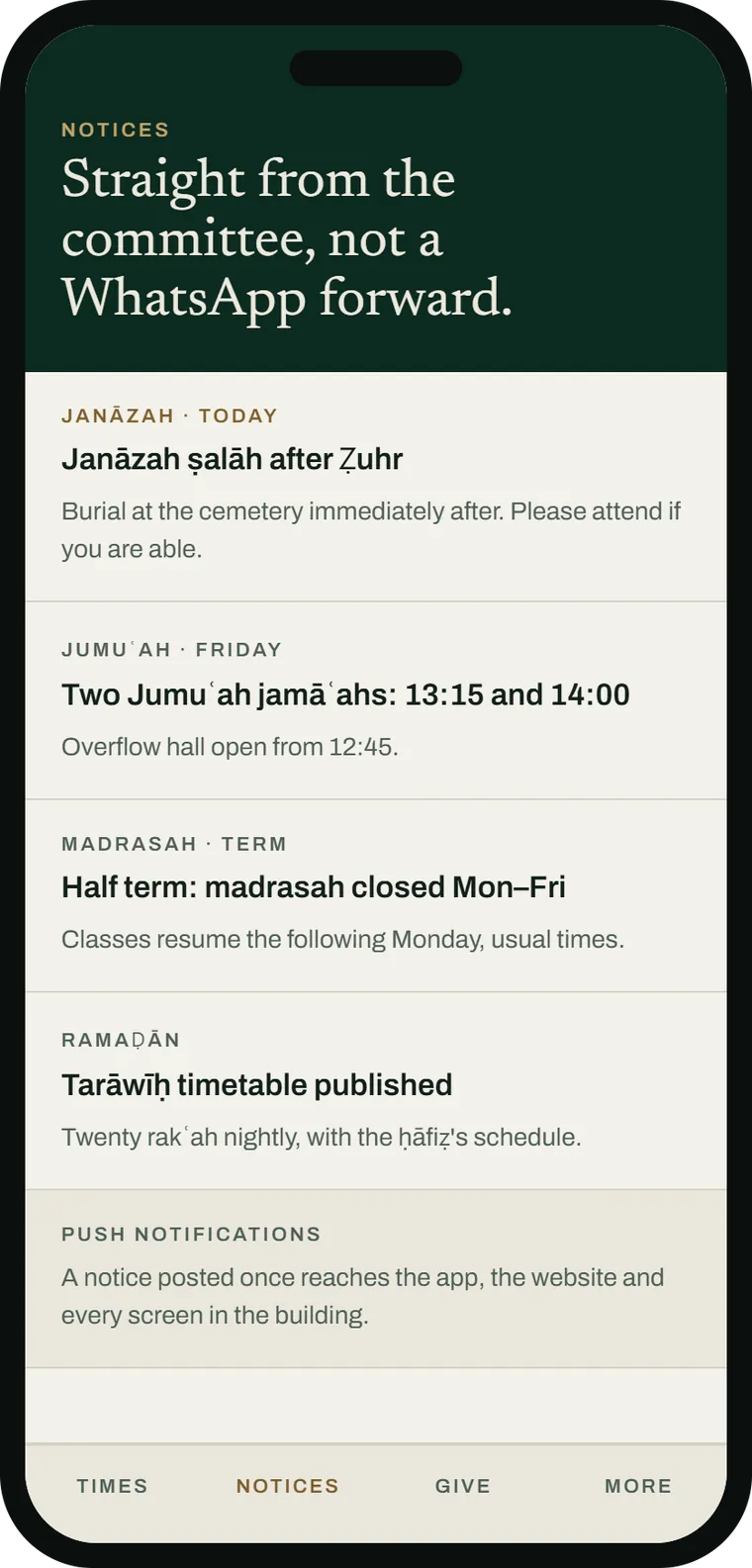
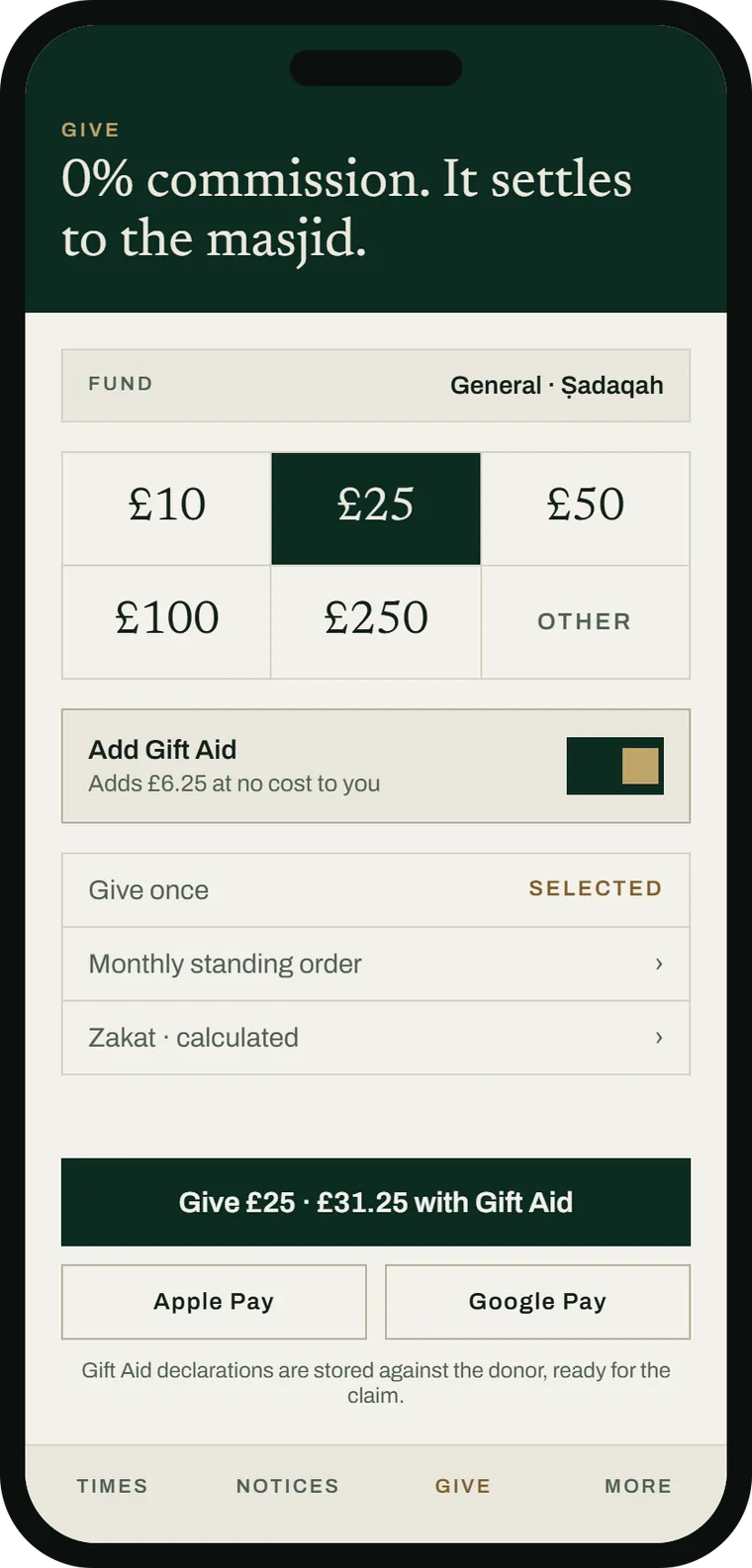
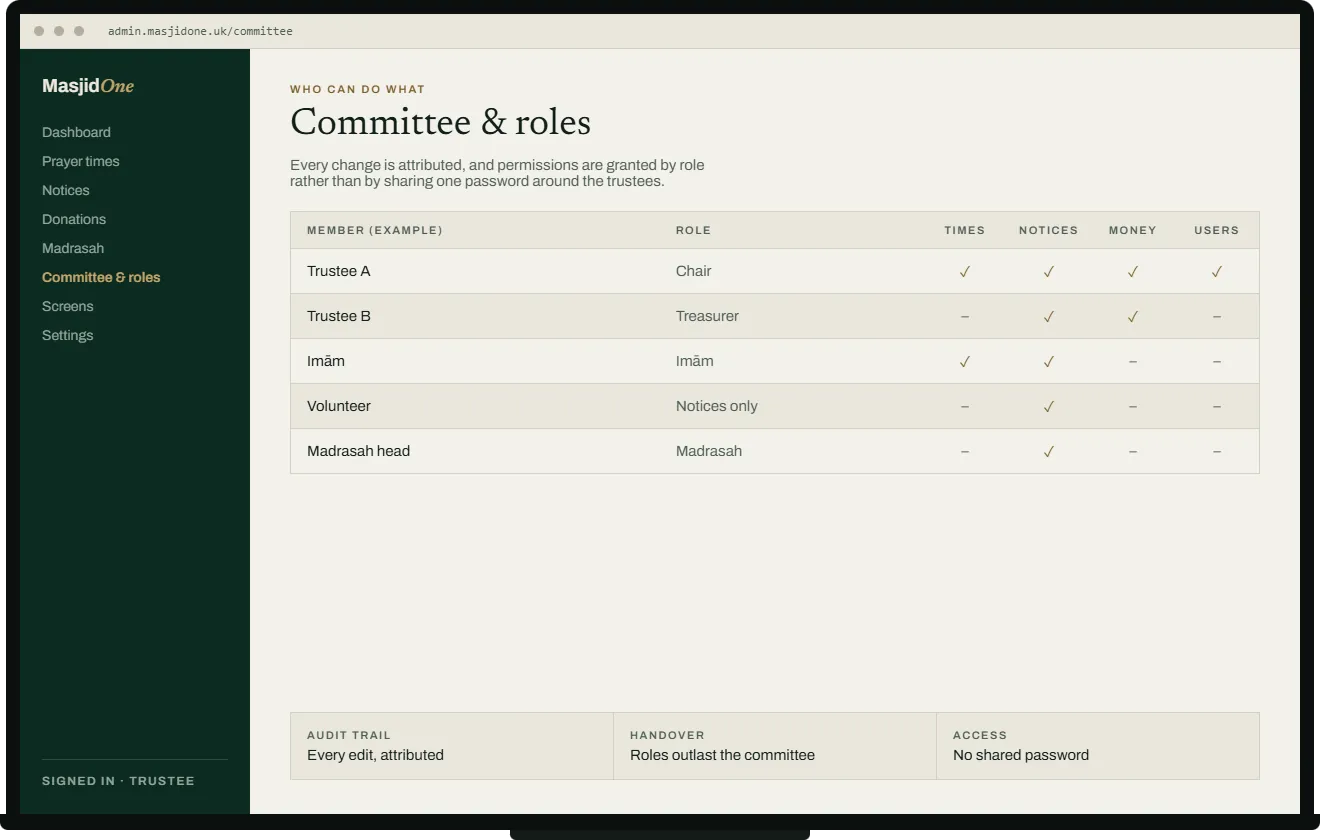
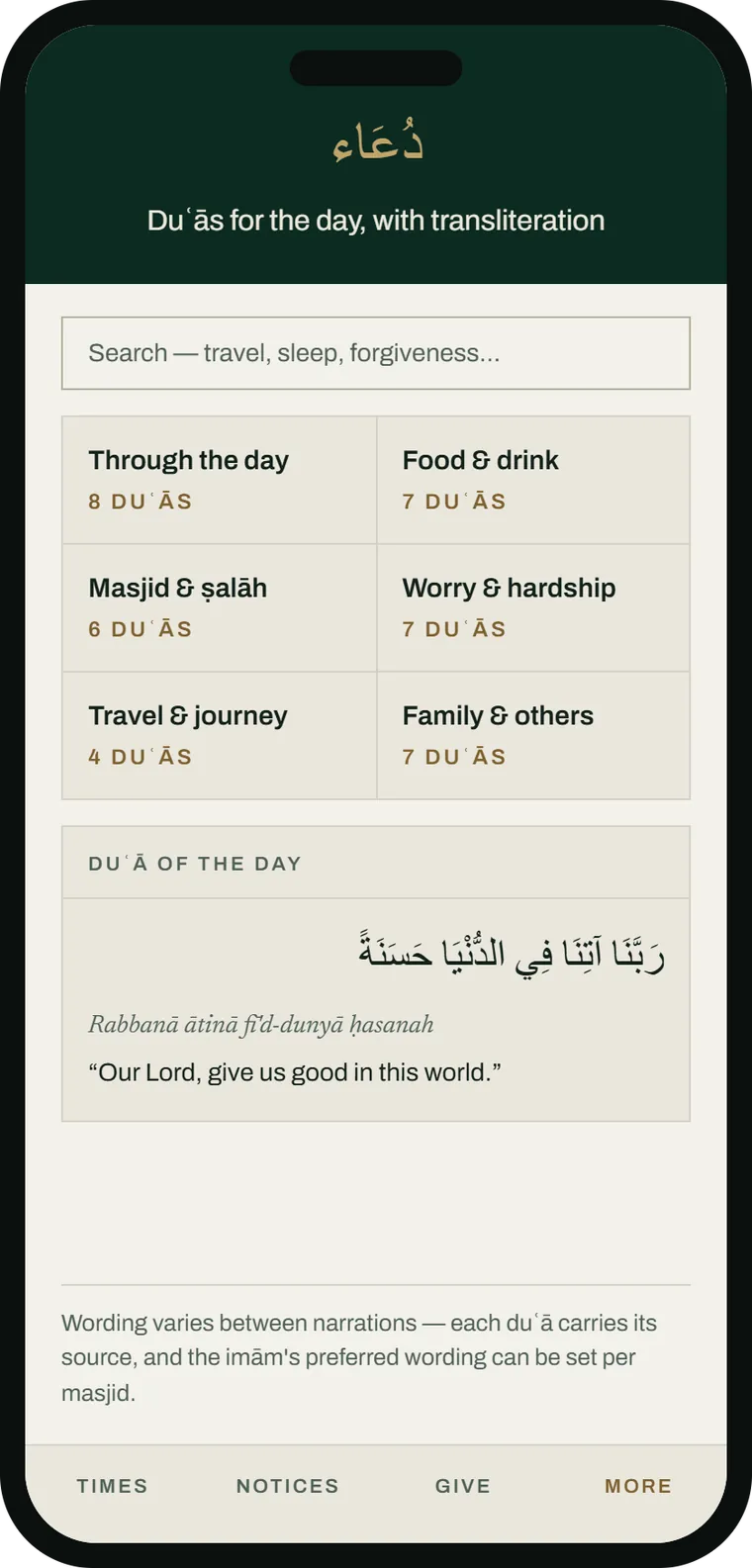
See it working
The join
One keeps the children: registers, fees, progress. The other keeps the congregation: times, notices, giving. Both work. Neither knows the other exists, so the same family is entered twice, chased twice and counted twice.
| What it keeps | A madrasah systemKeeps the children's record. Never sees the masjid. | MasjidOneThe joinOne record of the family, reachable from both sides. | A congregation appKeeps the masjid's day. Never sees the madrasah. |
|---|---|---|---|
| Prayer times and jamāʿah reminders | No | Yes | Yes |
| Announcements and janāzah notices | No | Yes | Yes |
| Website and hall screens | No | Yes | Yes |
| Donations and Gift Aid | No | Yes | Yes |
| Daily registers and attendance history | Yes | Yes | No |
| Hifz and sabaq progress | Yes | Yes | No |
| Madrasah fees and automatic chasing | Yes | Yes | No |
| One record of the same family on both sides | No | Yes | No |
| Parents use the app they already have | No | Yes | No |
The rows nobody else fills are the product, and they are built: one record of the same family, reachable from both sides, and a parent who can open the app they already have and find their own child in it.
The bridge
A parent opens the app they already have for jamāʿah times and finds their own child: the register marked this evening, the sabaq heard this week, the fee due this month. One record of one family, reachable from both sides.
The man at Fajr and the man paying madrasah fees are the same man. No platform in either camp knows it.
The product thesis, in one line
What you run instead
Not one of these is the wrong tool. The problem is that a volunteer is holding them together by hand, and the joins are where families get lost.
Built by somebody's nephew, or on a builder subscription nobody can log into any more. The prayer times on it are months out.
Calculated times rather than the ones on your board, so the app and the hall disagree and the congregation trusts neither.
It takes a percentage, and the list of who gave lives with them rather than with the masjid.
Announcements and janāzah notices sent by bulk text or a WhatsApp broadcast, to whichever numbers somebody remembered to add.
One teacher's handwriting, one drawer. Nobody can answer who missed three weeks running without turning pages.
Out of date the week after it was made, and living on one volunteer's laptop.
What it runs
The madrasah
The congregation
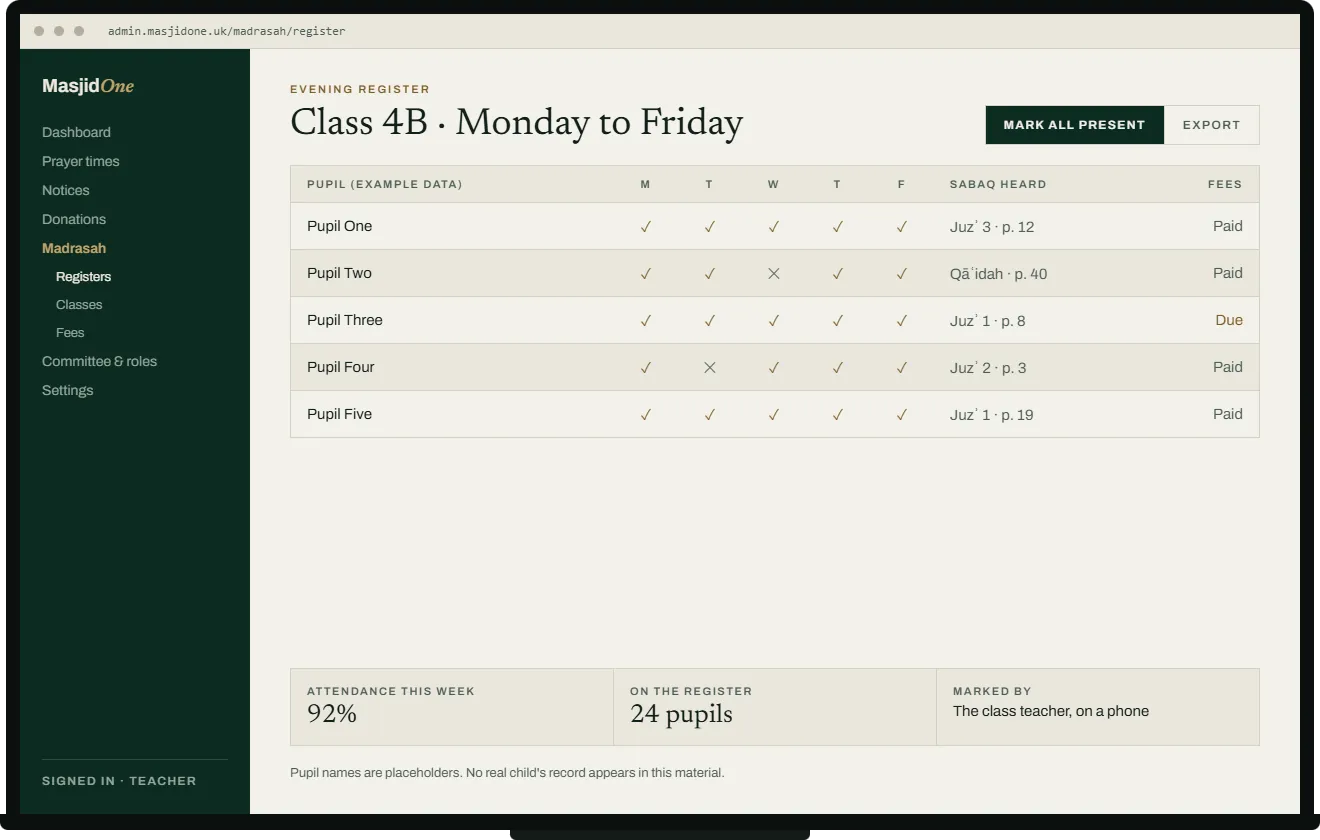
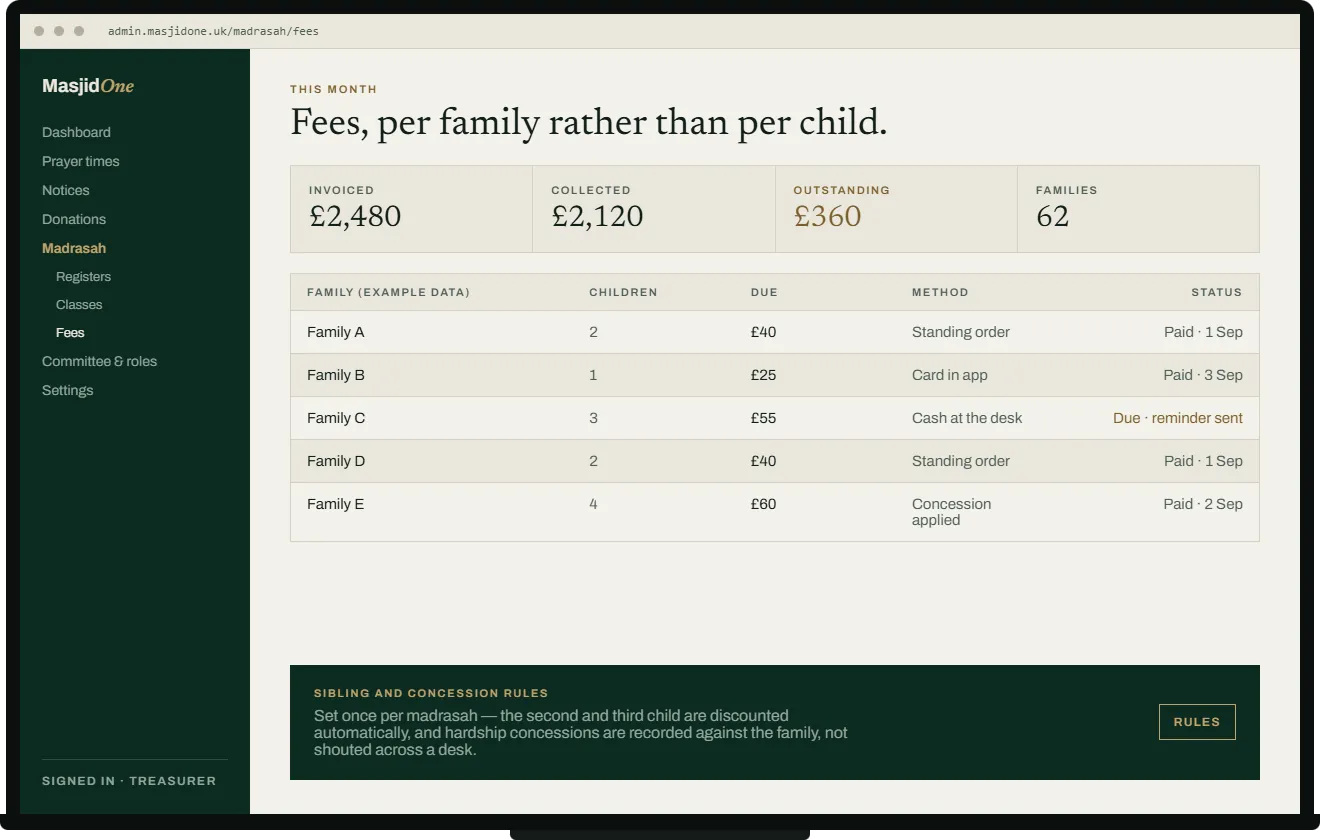
Pupils, classes, households and staff, with every teacher on their own login. Daily registers — drafted, submitted, locked, and chased when one is missed. Fees charged per family, with balances, payments and automatic reminders. Unlimited pupils and teachers — no per-pupil pricing and no paid add-ons; the price follows your size band, not your headcount.
Absence alerts the same evening, fees paid in two taps, progress a parent can actually read — inside the congregation app they already have. No second app to install. This is the bridge, and it is the whole claim.
The masjid's own timetable, not a calculated one. Jamāʿah reminders with a per-person offset, so a man who needs twenty minutes gets twenty minutes. Qibla, Zakat calculator, announcements, one-tap giving.
A managed mosque website kept current from the same place as everything else, and unlimited screens on ordinary televisions. Live announcements and janāzah notices reach the hall and the phone together.
Access set by role, not by a shared password. Who can change the jamāʿah times, who can publish an announcement or a janāzah notice, who can see the donation figures. The committee sees committee-level data; nobody sees everything by default. Teacher and parent roles arrive with the madrasah portal.
Card, Apple Pay and Google Pay. One-off or recurring, appeal campaigns, Gift Aid claimed at the point of giving. 0% commission, permanently. Every pound given reaches the masjid.
Previews
Interface previews, not photographs of a running masjid. Every figure is example data, and no child’s record or family’s fee history appears in any of them. The walkthrough at the top of the page is the real thing.
Setting up
Done once, at the start, by us. It is the part a committee is right to ask about, so here it is in full rather than in a footnote.
From paper, a spreadsheet, or whatever system you are on now. Nobody at the masjid retypes a single name.
On the system they will actually use, before the first register is marked. Migration from paper is usually the simpler one.
The masjid's own jamāʿah times loaded as they are on the board, not a calculation that drifts from it.
Madrasahs change systems between years, not in the middle of one. The switch works to your calendar, not ours.
ICO registration and a signed data processing agreement for your masjid, in place before the first bill is raised.
That deserves a straight answer before a signature, not a privacy policy nobody reads. Here is what is committed in writing before a masjid is ever invoiced.
Talk to us
We open the real system rather than a slide deck — a register marked, a family’s fees, the hall screen, and a parent finding their own child in the app. Nothing to cancel if it is not for you.